Node.js vs Laravel for Backend APIs: Technical Comparison
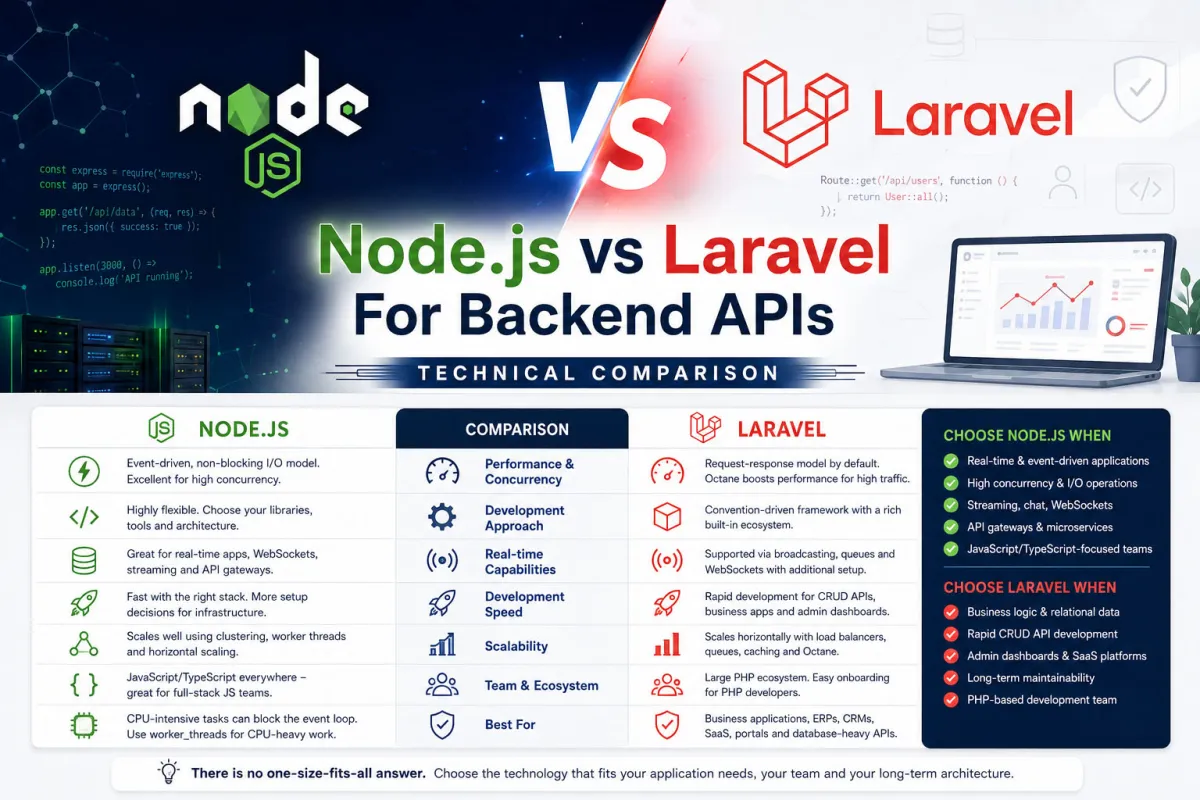
Choosing the backend technology for an API is not simply a question of which framework is faster. Architecture, developer experience, concurrency requirements, database interaction, maintainability, deployment infrastructure, and the skills of your existing team can matter just as much as raw benchmark numbers.
Two technologies that frequently appear in this discussion are Node.js and Laravel. They can both power production APIs, but they approach backend development very differently.
Node.js is a JavaScript runtime designed around asynchronous, event-driven execution. Its event loop enables efficient non-blocking I/O, making it particularly attractive for applications that maintain many simultaneous network connections.
Laravel, on the other hand, is a structured PHP web application framework. It provides developers with an integrated ecosystem for routing, database access, validation, authentication, queues, background jobs, testing, and other common application requirements.
So which should you choose for your next API?
The answer depends much more on what you are building than on which technology wins a generic performance test.
Node.js and Laravel Are Not the Same Type of Technology
Before comparing them, there is an important distinction.
Node.js is a runtime environment. Developers normally combine it with a framework such as Express, Fastify, NestJS, or another JavaScript/TypeScript backend framework.
Laravel is already a complete application framework.
This means a comparison between "Node.js vs Laravel" is really a comparison between two development approaches:
JavaScript/TypeScript-based server applications built on Node.js
Structured PHP applications built with Laravel
Node.js generally gives developers more freedom to assemble their preferred architecture.
Laravel provides more conventions and functionality out of the box.
Neither approach is automatically better. The right choice depends on whether your project benefits more from flexibility or from an opinionated framework.
Performance and Request Handling
Performance is often the first point raised in a Node.js versus Laravel discussion, but it is also one of the most misunderstood.
Node.js uses an event loop and non-blocking I/O model. A request waiting for a database, external API, file operation, or network response does not necessarily need to block the main JavaScript execution flow. This design makes Node.js particularly suitable for workloads involving large amounts of concurrent I/O.
However, Node.js does not magically make every workload faster.
CPU-intensive JavaScript can block the main event loop. Node provides worker_threads for parallel CPU-intensive operations, while clustering or multiple application instances can be used to leverage additional resources. Node's own documentation specifically notes that worker threads are useful for CPU-intensive JavaScript and generally provide little benefit for I/O-heavy work, where asynchronous I/O is already efficient.
Traditional Laravel applications follow a request-response model where PHP processes the incoming request and returns the response. For many business APIs, this model is more than adequate.
Laravel can also use Octane, which keeps the application in memory and serves requests through long-running application servers, reducing some of the repeated framework bootstrapping associated with the conventional PHP request lifecycle.
The practical conclusion is simple:
Do not select either platform purely from synthetic requests-per-second benchmarks.
Database queries, caching, external services, application architecture, network latency, server resources, and inefficient code often have a much greater impact on real-world API performance.
Concurrency and Real-Time Applications
This is one area where Node.js has a natural architectural advantage.
Consider applications such as:
Live chat
Collaborative editing
Real-time dashboards
Multiplayer services
Notification systems
Streaming applications
WebSocket-heavy platforms
API gateways handling many external connections
Node.js's event-driven architecture is well suited to maintaining many concurrent I/O operations without creating a dedicated JavaScript execution thread for every connection.
Laravel can absolutely support real-time functionality as well. A Laravel application may use broadcasting, WebSockets, queues, and dedicated services around its primary application.
The difference is that real-time I/O is closer to Node.js's fundamental programming model, whereas Laravel is particularly strong when the application revolves around structured business workflows and database-backed operations.
API Development Speed
For conventional business APIs, Laravel can be extremely productive.
Imagine building an API containing:
Users
Customers
Products
Orders
Invoices
Permissions
Notifications
Reports
Background jobs
These systems usually need repetitive application infrastructure: database models, migrations, validation, authentication, routing, queues, scheduled jobs, and authorization rules.
Laravel provides strong conventions and integrated tools for these requirements. Its structured approach reduces the number of architectural decisions a development team must make before business development can begin.
Node.js can also provide excellent development speed, particularly with a framework such as NestJS or Fastify, but the JavaScript ecosystem gives teams considerably more architectural freedom.
That flexibility can be useful, but it can also result in different Node.js projects using completely different combinations of libraries for validation, authentication, ORM, dependency injection, and application structure.
Development Philosophy
Area | Node.js | Laravel |
|---|---|---|
Core language | JavaScript / TypeScript | PHP |
Nature | Runtime | Full framework |
Architecture | Highly flexible | Convention-driven |
Concurrency model | Event-driven | Request-response by default |
Real-time workloads | Natural fit | Supported with additional architecture |
Database applications | Excellent with chosen ORM | Strong integrated ORM workflow |
Rapid CRUD APIs | Depends on framework | Excellent |
Full-stack language reuse | JavaScript frontend + backend | PHP backend |
Background processing | Ecosystem-based | Integrated queue abstraction |
Best advantage | Concurrency and flexibility | Productivity and structure |
Laravel queues provide a unified interface for background jobs across different queue backends, which is particularly useful for email, imports, exports, notifications, image processing, and other tasks that should not delay an API response.
Database-Heavy Business Applications
Many APIs spend far more time interacting with databases than executing application code.
An ERP, CRM, ordering platform, or inventory system may require hundreds of relationships, validations, filters, and reporting queries.
Laravel's structured database workflow is especially useful for this type of software. Models, migrations, relationships, query building, pagination, validation and authorization fit naturally into the framework's conventions.
This can make Laravel particularly attractive for:
ERP and CRM systems, admin dashboards, B2B portals, procurement systems, SaaS applications, booking platforms and other database-heavy software.
Node.js can handle these applications just as successfully, especially with a well-designed TypeScript architecture, but the development team must make more decisions regarding the libraries and architectural conventions it wants to standardise.
JavaScript Everywhere: Node.js's Major Advantage
Node.js offers something Laravel cannot: the possibility of using the same primary programming language throughout much of the technology stack.
A team building React, Vue, Angular, or another JavaScript frontend can also use JavaScript or TypeScript for the backend.
This can simplify:
developer hiring,
shared validation logic,
type definitions,
frontend/backend collaboration,
internal tooling,
and certain full-stack workflows.
For smaller teams, having developers comfortable across both frontend and backend JavaScript can be valuable.
However, using one language everywhere should not itself determine architecture. A well-built Laravel API with a React frontend is perfectly normal, and separation between frontend and backend can often be beneficial.
Maintainability and Team Structure
Laravel's opinionated nature becomes particularly valuable as applications grow.
Two Laravel developers joining the same conventional Laravel project will generally recognise familiar locations for controllers, models, migrations, middleware, commands, jobs and other application components.
Node.js projects can vary much more.
One team may use Express and Prisma. Another may use NestJS and TypeORM. Another may use Fastify with entirely different libraries.
This is not a weakness of Node.js. It is a consequence of its flexibility.
For experienced engineering teams that intentionally define architecture standards, this flexibility is extremely powerful.
For teams that prefer strong conventions and predictable project organisation, Laravel often reduces architectural inconsistency.
Scalability
Both platforms can scale well.
Node.js applications are commonly scaled using multiple processes or instances behind a load balancer. Its asynchronous model is particularly efficient where servers spend much of their time waiting for network or I/O operations. Node's cluster facilities support running multiple worker processes, while worker threads are available for appropriate CPU-intensive work.
Laravel applications can also scale horizontally using multiple application servers, database optimisation, Redis, caching, queues and load balancing.
For higher-throughput Laravel workloads, Octane provides another option by keeping the framework bootstrapped in memory between requests.
In both cases, mature scaling usually depends on architecture rather than language alone:
Use caching appropriately.
Optimise database indexes and queries.
Move expensive background work to queues.
Avoid unnecessary external calls.
Use monitoring and profiling.
Scale application instances horizontally where required.
A poorly designed Node.js application will not automatically outperform a well-optimised Laravel application.
The reverse is equally true.
Security
Neither Node.js nor Laravel should be considered inherently “secure” simply because of the technology being used.
Security depends on implementation, dependency management, authentication design, input validation, authorization, infrastructure configuration, patching and operational discipline.
Laravel's integrated framework can reduce the amount of custom infrastructure developers must write for common application tasks.
Node.js provides a very large package ecosystem, which offers enormous flexibility but makes disciplined dependency selection and maintenance important.
Regardless of platform, API security should include appropriate controls for:
authentication,
authorization,
validation,
rate limiting,
secure secrets management,
dependency updates,
HTTPS,
logging,
database permissions,
and infrastructure security.
When Should You Choose Node.js?
Node.js becomes particularly compelling when concurrency and real-time communication are central to the product.
Consider Node.js when your project involves:
WebSockets or real-time communication
Streaming
Chat or collaboration
API gateways
Many simultaneous external API calls
Event-driven microservices
A JavaScript/TypeScript-focused engineering team
Shared frontend/backend TypeScript workflows
Its non-blocking architecture provides a strong foundation for applications dominated by asynchronous I/O.
When Should You Choose Laravel?
Laravel is an excellent choice when the API represents complex business rules and structured data.
Consider Laravel for:
SaaS applications
CRM and ERP platforms
E-commerce systems
Ordering and procurement software
Admin-heavy applications
Business dashboards
Booking applications
Client portals
Financial workflows
Content and publishing systems
APIs tightly integrated with relational databases
Laravel is also highly attractive when development speed, maintainability, and predictable architecture matter more than building a highly specialised event-driven system.
Can Node.js and Laravel Be Used Together?
Yes, and sometimes this is better than forcing one technology to handle every requirement.
For example, Laravel could manage:
authentication,
customers,
orders,
billing,
administration,
reporting,
and relational business data,
while a Node.js service handles:
WebSocket connections,
live notifications,
streaming,
or another highly concurrent real-time workload.
This architecture adds operational complexity, so it should only be introduced when the benefits justify maintaining multiple backend technologies.
For many projects, one well-designed backend is still the better engineering choice.
Node.js vs Laravel: Which Is Better?
There is no universal winner.
If your API is heavily real-time, connection-heavy, or asynchronous, Node.js deserves serious consideration.
If your application is primarily business-process driven, relational and CRUD-heavy, Laravel can often get a team to a maintainable production system faster.
The most important question is not:
"Which technology is faster?"
It is:
"Which architecture allows our team to build, operate, and maintain this application reliably for the next several years?"
For most businesses, maintainability, database design, infrastructure, security, observability, and developer expertise will have a greater long-term effect than the programming language printed on the benchmark chart.
Frequently Asked Questions
Is Node.js faster than Laravel for APIs?
Node.js can have an advantage in workloads involving large numbers of concurrent I/O operations because of its event-driven, non-blocking architecture. However, actual API performance depends heavily on database queries, caching, server configuration, and application architecture. Laravel can also use Octane for long-running high-performance application servers.
Is Laravel suitable for high-traffic APIs?
Yes. Laravel applications can be horizontally scaled, cached, and supported by queues, Redis, database replicas, and load balancers. High traffic requires good architecture regardless of framework.
Is Node.js better for microservices?
Node.js is a strong choice for lightweight, event-driven, and I/O-heavy services, but Laravel can also be used successfully in service-oriented architectures. The decision should be based on service requirements rather than the term “microservices” itself.
Which is easier to develop with?
For structured business applications, Laravel provides many conventions and integrated components that can reduce development time. Node.js offers more architectural freedom, which can be an advantage for experienced teams but requires more technology decisions.
Can Laravel build real-time APIs?
Yes. Real-time behaviour can be added around Laravel using broadcasting, WebSockets, queues and appropriate infrastructure. Node.js simply makes event-driven I/O a more fundamental part of its programming model.
Should a React application use Node.js instead of Laravel?
Not necessarily. React can communicate with any HTTP API. Choosing Node.js only because the frontend uses JavaScript is useful when shared language or TypeScript models provide a meaningful development advantage, but it is not a technical requirement.
Which is better for an ERP or business management system?
Laravel is often particularly productive for applications dominated by relational data, permissions, forms, workflows, reporting, and administrative interfaces. Node.js can build the same systems, but Laravel's conventions can reduce repetitive application architecture.
Can CPU-heavy work cause problems in Node.js?
Yes. CPU-intensive JavaScript can occupy the main event loop. Node.js provides worker threads specifically for parallel CPU-intensive JavaScript work.
Final Verdict
Choose Node.js when concurrency, event-driven architecture, real-time communication, or a JavaScript-centric stack are major requirements.
Choose Laravel when rapid business application development, relational data, strong conventions, and long-term maintainability are more important.
Both technologies are capable of powering serious backend APIs.
The better choice is the one that fits your application's workload, your development team, and your long-term architecture-not the one with the most impressive isolated benchmark.
Tagged in

Written by
Madhavendra DuttI build modern, high-performance websites and provide secure hosting and strategic digital marketing solutions that help businesses grow online. My focus is on clean development, speed, reliability, and measurable results.
View all posts →Related Posts
Continue exploring similar topics
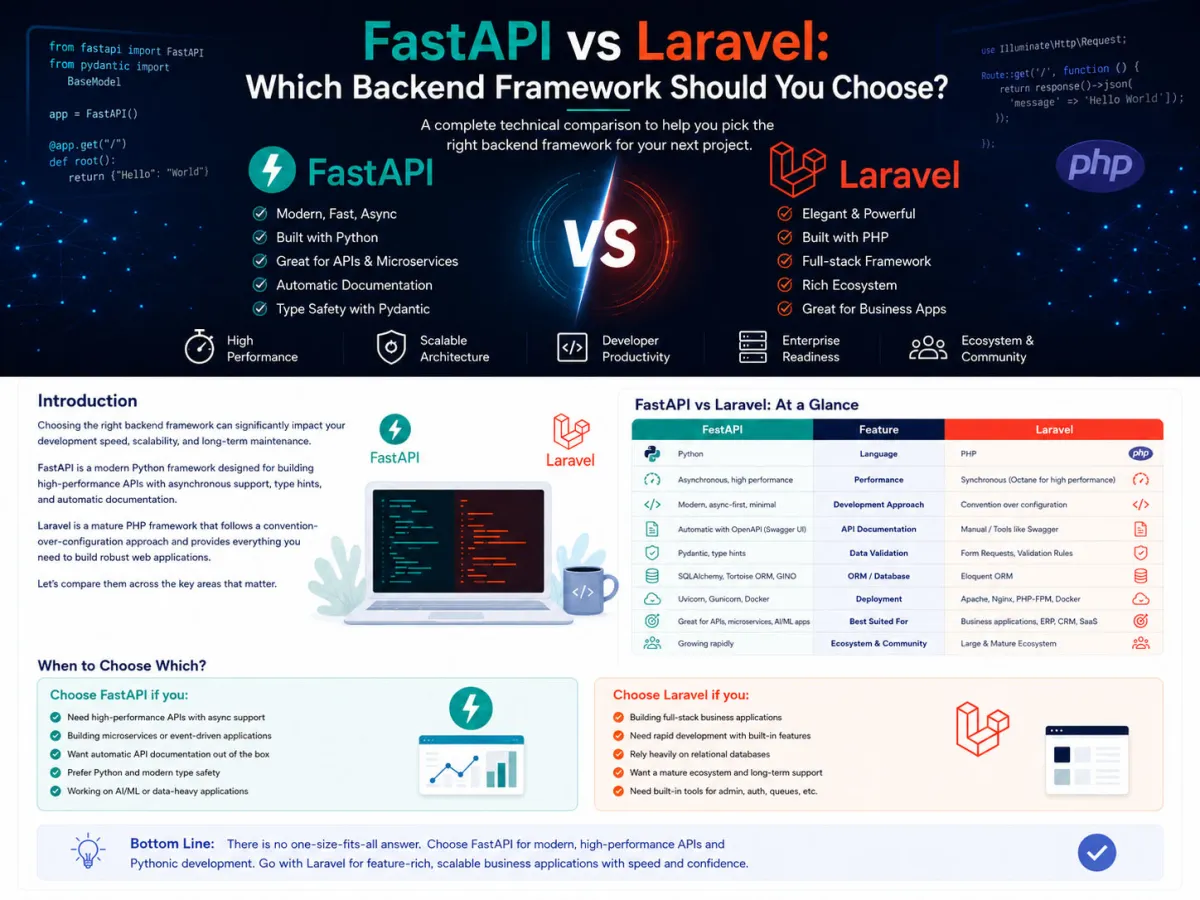
Compare FastAPI and Laravel across performance, async APIs, scalability, AI integration, d...

See how we replaced spreadsheets, messages, and manual approvals with a centralized orderi...
Discover the real difference between no-code and custom development. Learn which approach...