No-Code vs Custom Development: What’s the Real Difference?
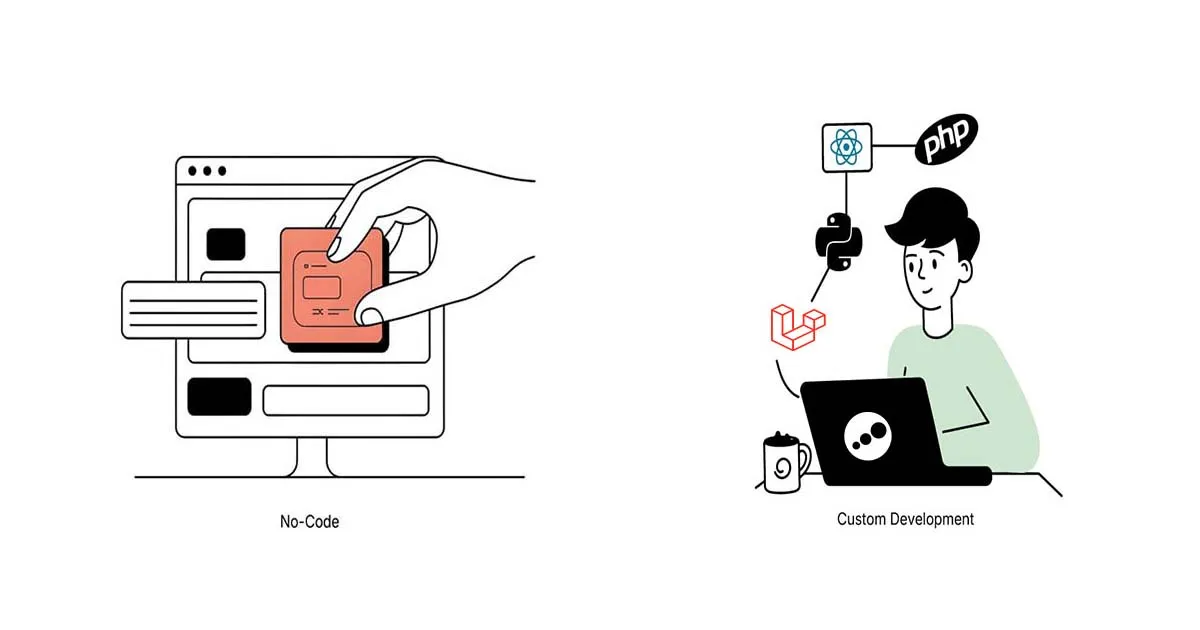
In today's fast-moving digital landscape, businesses are constantly looking for the quickest and most efficient way to build websites and applications. This has led to the rise of no-code platforms alongside traditional custom web development.
But choosing between the two isn't just about speed; it's about scalability, control, performance, and long-term value.
Let's break down the real difference.
What is No-Code Development?
No-Code platforms are essentially sophisticated visual layers built on top of existing codebases. They allow users to bypass the traditional development cycle by using pre-built components. This is the ideal environment for Rapid Prototyping or launching a Minimum Viable Product (MVP). When time-to-market is the primary KPI, No-Code wins by a landslide. It eliminates the need for a dedicated backend team for simple workflows, making it a favorite for small businesses and internal departmental tools.
No-code development allows users to build websites or applications without writing code. Platforms such as website builders and automation tools offer drag-and-drop interfaces, making development accessible to non-technical users.
These platforms are ideal for:
Small business websites
Landing pages
MVPs (Minimum Viable Products)
Quick prototypes
The biggest advantage here is speed. You can go live in days instead of weeks.
However, convenience often comes with limitations.
What is Custom Development?
Custom development involves building a website or application from scratch using programming languages and frameworks (like Laravel, React, etc.).
Unlike no-code tools, custom development gives you:
Full control over functionality
Tailored user experience
Better performance optimization
Scalability for future growth
This approach is commonly used for:
SaaS platforms
Enterprise applications
High-performance websites
Complex integrations
While it requires more time and expertise, the result is far more flexible and powerful.
Key Differences Between No-Code and Custom Development
1. Flexibility & Control
No-code platforms operate within predefined limits. You can only build what the platform allows.
Custom development, on the other hand, gives you complete freedom. If you can imagine it, you can build it.
2. Performance
No-code websites often include unnecessary code and dependencies, which can slow down performance.
Custom-built websites are optimized for speed, making them better for website performance optimization and SEO.
3. Scalability
As your business grows, your website needs to handle more traffic and features.
No-code solutions can struggle here, while custom development is designed to scale seamlessly with proper database optimization and architecture.
4. Cost Over Time
No-code tools are cheaper upfront, but often come with:
Monthly subscriptions
Plugin costs
Limited scalability
Custom development requires a higher initial investment but pays off in the long run with better ROI.
5. SEO Capabilities
No-code platforms offer basic SEO features, but they often lack advanced control.
Custom-built websites allow full control over:
Page speed
Technical SEO
Structured data
URL structure
This makes a huge difference in achieving higher Google rankings.
When Should You Choose No-Code?
No-code is a smart choice if:
You need a quick launch
You have a limited budget
Your project is simple
You don’t need advanced features
It’s perfect for startups testing ideas.
When is Custom Development the Better Option?
Custom development is the right choice if:
You need a scalable solution
You want complete control
Performance and SEO matter
Your project involves complex features
For businesses aiming for long-term growth, this is usually the better investment.
Comparison at a Glance
Feature | No-Code Platforms | Custom Development |
Development Speed | Extremely Fast (Days) | Moderate to Slow (Months) |
Cost | Low Initial Investment | Higher Upfront Cost |
Flexibility | Limited by Platform Features | Infinite / Fully Bespoke |
Scalability | Standard Scaling Options | Highly Scalable & Optimized |
Ownership | Platform Dependent | Full IP Ownership |
The Real Difference
No-code is about speed and simplicity, while custom development is about power, flexibility, and long-term growth.
Conclusion
There's no one-size-fits-all answer. The right choice depends on your business goals, budget, and plans.
If you're building something simple, no-code can get you started quickly. But if you're serious about performance, scalability, and SEO, custom development is the way forward.
FAQs
1. Is no-code better for beginners?
Yes, no-code platforms are beginner-friendly and require no programming knowledge.
2. Can no-code websites rank on Google?
Yes, but they may struggle with advanced SEO compared to custom-built websites.
3. Is custom development expensive?
It has a higher upfront cost, but it’s more cost-effective in the long term due to scalability and performance.
4. Can I switch from no-code to custom later?
Yes, but it may require rebuilding your website from scratch. This is often called "Re-platforming" or a Website Redesign. You use No-Code to prove the concept, then invest in custom code to handle high traffic and complex features.
5. Which is better for SEO?
Custom development is better because it allows full control over technical SEO and performance.
Tagged in

Written by
Madhavendra DuttI build modern, high-performance websites and provide secure hosting and strategic digital marketing solutions that help businesses grow online. My focus is on clean development, speed, reliability, and measurable results.
View all posts →Related Posts
Continue exploring similar topics
Compare FastAPI and Laravel across performance, async APIs, scalability, AI integration, d...
Node.js or Laravel for backend APIs? Compare performance, concurrency, scalability, develo...
See how we replaced spreadsheets, messages, and manual approvals with a centralized orderi...