FastAPI vs Laravel: Which Backend Framework Should You Choose?
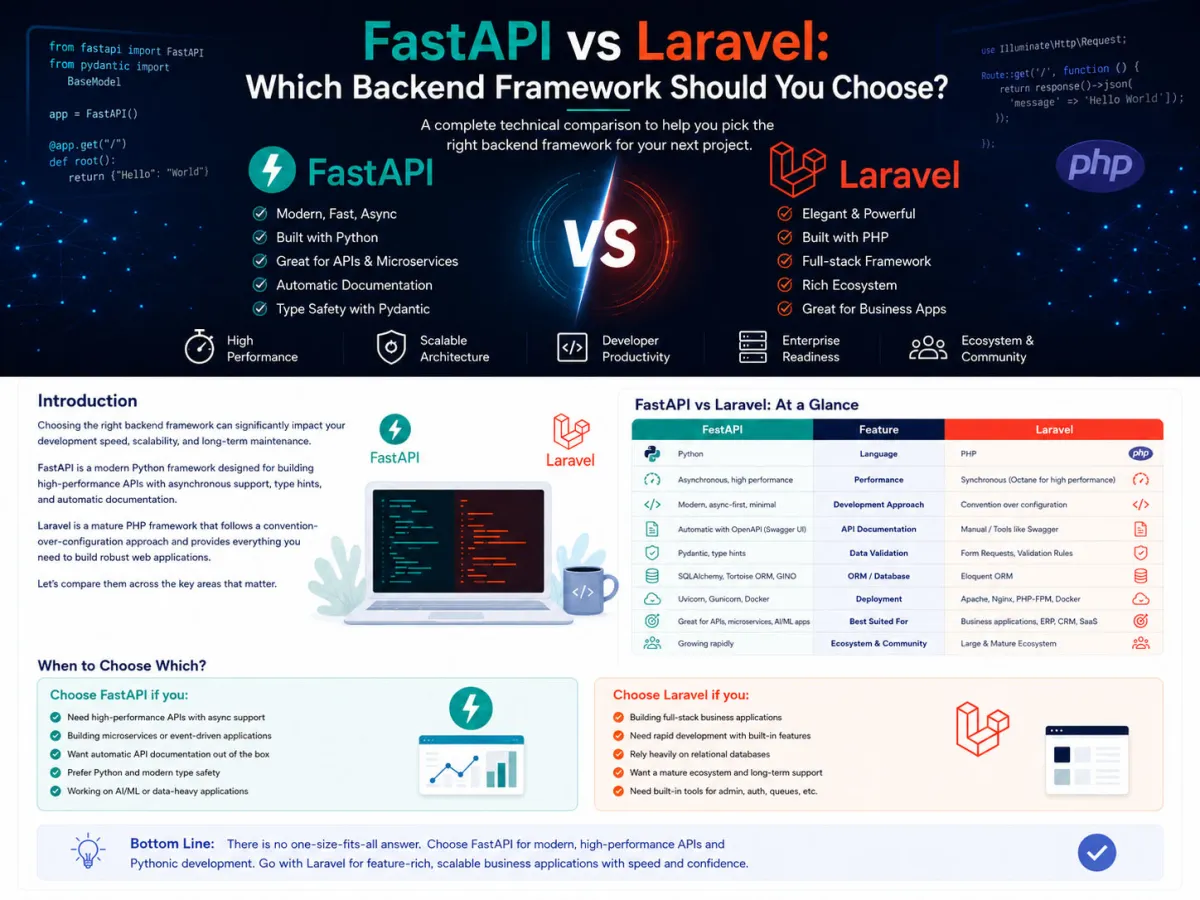
Choosing a backend framework is rarely about finding the framework with the highest benchmark score. The better question is whether the framework fits your application's architecture, data model, development team, expected traffic, deployment environment, and long-term maintenance requirements.
FastAPI and Laravel are both capable of powering production backend systems, but they approach application development from very different directions.
FastAPI is a modern Python framework created specifically for building APIs. It uses standard Python type hints for request handling and validation and generates OpenAPI-based API documentation automatically. Laravel, meanwhile, is a full PHP web application framework with an extensive ecosystem covering routing, database access, queues, caching, validation, rate limiting, background processing, testing, and other common application requirements.
So which one should you choose?
The answer depends less on whether Python or PHP is faster and more on what kind of backend you actually need to build.
FastAPI and Laravel Have Different Philosophies
FastAPI is fundamentally API-first.
Its design revolves around defining endpoints, declaring request and response structures with Python types, validating incoming data and exposing the resulting API specification through OpenAPI. Swagger UI and ReDoc interfaces are included by default, making an API immediately explorable during development.
Laravel is broader.
It is designed as a complete application framework rather than only an API layer. A Laravel project can contain APIs alongside authentication, database models, queues, scheduled operations, web interfaces, administrative workflows, notifications, events, and other application components.
That gives us the first important distinction:
FastAPI provides a focused Python foundation for APIs. Laravel provides a structured ecosystem for complete business applications.
Neither philosophy is inherently superior. The right one depends on the scope of your system.
Performance and Concurrency
Performance is one of FastAPI's biggest attractions.
FastAPI supports both conventional Python functions and async def path operations. Its asynchronous programming model is particularly useful when the application spends a significant amount of time waiting for I/O, such as external APIs, databases, files, or remote network services.
Imagine an endpoint that needs to call several third-party APIs before returning a response. While one operation is waiting for a remote server, asynchronous execution can allow the application to work on other requests instead of simply waiting.
This makes FastAPI particularly attractive for:
APIs making many external service calls
AI gateways
orchestration services
data aggregation APIs
microservices
asynchronous database workloads
applications with substantial network I/O
However, asynchronous programming should not be confused with unlimited performance.
CPU-intensive calculations still consume processor time and may need separate workers, processes, or specialised infrastructure.
Laravel traditionally operates through PHP's request-response execution model, where the framework is bootstrapped to process an incoming request and then returns the result.
For applications needing a different execution model, Laravel Octane can keep the application loaded in memory and serve requests through high-performance application servers such as FrankenPHP, Open Swoole, Swoole or RoadRunner.
Laravel also now provides a Concurrency facade for running independent operations concurrently where appropriate.
The important takeaway is that framework benchmarks rarely tell the whole story.
In real applications, performance can be affected more by:
inefficient SQL queries,
missing database indexes,
slow external APIs,
poor caching,
excessive serialization,
network latency,
storage performance,
A properly designed Laravel API may outperform a badly designed FastAPI application, and the reverse is equally true.
Development Experience
FastAPI offers an elegant development experience for API-centric projects.
A developer can define Python types for incoming data, and FastAPI can use those declarations to validate requests and describe the API schema. The same application can expose interactive API documentation through Swagger UI without requiring developers to maintain a completely separate documentation specification.
For teams developing APIs consumed by mobile apps, React applications, external integrations, or other internal services, this can save considerable development effort.
Laravel approaches productivity differently.
Instead of concentrating almost exclusively on the API contract, Laravel provides conventions for the wider application.
A typical Laravel application might contain:
routes,
controllers,
middleware,
models,
migrations,
validation,
authorization,
queues,
scheduled commands,
events,
notifications,
tests,
caching,
and background workers.
Laravel therefore tends to become especially productive when an API represents only one part of a larger application.
Automatic API Documentation
This is an area where FastAPI has a clear advantage out of the box.
FastAPI is built around OpenAPI and includes two documentation interfaces by default:
Swagger UI for interactive API exploration and testing, and ReDoc for an alternative documentation interface.
Developers can open the documentation endpoint and interact with API routes directly from the browser.
This is valuable when APIs are consumed by:
frontend developers,
mobile developers,
third-party integrators,
external customers,
internal engineering teams,
or other microservices.
Laravel can absolutely provide OpenAPI documentation as well, but teams generally introduce additional tooling or packages for that workflow.
If API contracts and documentation are central to the product, FastAPI provides an exceptionally convenient development experience.
Validation and Type Safety
FastAPI makes Python's type system an important part of API development.
Type annotations can describe expected parameters and request models. FastAPI then uses these declarations during request processing and generates the corresponding API schema.
This can provide excellent editor assistance and makes API contracts easy to understand directly from the code.
Laravel uses a comprehensive validation system instead.
Laravel validation is particularly comfortable for business applications because validation rules can incorporate application requirements such as database existence checks, uniqueness rules, dates, files, arrays, and custom business conditions.
The philosophical difference is important:
FastAPI begins with typed API contracts.
Laravel begins with structured application workflows.
Both approaches can produce reliable APIs.
Database-Heavy Business Applications
Now consider a very different type of project.
Suppose you are developing an ERP or SaaS platform containing:
clients,
branches,
products,
orders,
approvals,
invoices,
payments,
budgets,
permissions,
reporting,
notifications,
and audit history.
In such systems, the majority of development effort may have very little to do with HTTP performance.
The real complexity lies in business rules and relationships.
Laravel is particularly comfortable with this kind of application because the framework offers consistent conventions around database-oriented application development and surrounding infrastructure.
FastAPI intentionally leaves more architectural choices to the developer. Teams can select the database library, ORM, dependency architecture, and background-processing stack that best suit their project.
That freedom is powerful.
But it also means two FastAPI applications may be structured very differently depending on the developers who created them.
For experienced Python engineering teams, this flexibility can be a major advantage.
For organisations that want developers to immediately understand the structure of an existing application, Laravel's conventions can reduce architectural inconsistency.
Background Jobs and Queues
Many backend operations should not run during the HTTP request itself.
For example:
sending email,
processing uploaded files,
importing thousands of records,
generating reports,
creating PDFs,
synchronising external data,
resizing images,
or sending notifications.
FastAPI includes support for running lightweight background tasks after returning a response. Its documentation also notes that background task functions can use either normal def or async def.
For substantial distributed workloads, Python applications often introduce dedicated task-processing infrastructure.
Laravel provides a unified queue API supporting multiple backends, including Redis, Amazon SQS, and relational databases. This makes queues a highly integrated part of the Laravel application architecture.
For applications where background processing is central to ordinary business workflows, Laravel's queue integration can reduce the number of architectural decisions required.
AI and Machine Learning Integration
This is one of FastAPI's strongest practical advantages.
FastAPI is written in Python, so an API can sit directly beside Python-based machine learning, AI, data-processing or scientific-computing code.
This makes it particularly attractive for applications exposing:
machine-learning models,
recommendation engines,
document analysis,
natural-language processing,
computer vision,
data transformation,
AI agents,
prediction models,
or Python automation.
Instead of creating an integration layer between two programming languages, developers can expose Python functionality through a FastAPI endpoint directly.
That does not mean Laravel is unsuitable for AI-enabled applications.
In fact, Laravel and FastAPI can work extremely well together.
Laravel can manage the main business application while a FastAPI microservice handles specialised Python workloads.
A Practical Laravel + FastAPI Architecture
Consider a SaaS platform containing an AI-powered document-analysis feature.
Laravel could manage:
user registration,
subscriptions,
customers,
payments,
permissions,
dashboards,
files,
usage records,
billing,
and administrative workflows.
FastAPI could manage:
document extraction,
embeddings,
AI processing,
model inference,
classification,
or recommendation algorithms.
Laravel sends a request to the FastAPI service, FastAPI performs the specialised computation, and the result is returned to the main application.
This is often better than selecting FastAPI simply because the application has one AI feature or selecting Laravel and then attempting to reproduce the Python ecosystem inside PHP.
Each technology can be used where it provides the greatest advantage.
API-First Microservices
FastAPI is extremely attractive for focused services.
Imagine an organisation with separate services for:
recommendations,
search,
notifications,
fraud detection,
analytics,
AI inference,
document processing,
or integration with third-party platforms.
FastAPI's small API-focused core, async capabilities, and automatically generated API documentation make it well suited to this style of architecture.
Laravel can also be used for services, but its strongest value often appears when developers make use of the wider framework rather than treating Laravel only as a thin HTTP layer.
Building SaaS Applications
For conventional SaaS products, Laravel can be particularly productive.
A SaaS application frequently needs much more than REST endpoints.
It may require:
authentication,
customers,
subscriptions,
billing,
roles and permissions,
email notifications,
background processing,
scheduled jobs,
reporting,
administrative dashboards,
cache management,
file storage,
and complex relational data.
Laravel's queueing, caching, rate-limiting, and broader framework ecosystem provide integrated building blocks for these requirements.
FastAPI can build the same application, but developers generally need to make more explicit choices about the supporting architecture.
If your team values that freedom, this may be desirable.
If the objective is to get a large business application into production quickly with strong conventions, Laravel may be more efficient.
Scalability
Both frameworks can scale.
FastAPI services can run as replicated application instances or inside container environments where concerns such as HTTPS, restarts, replication and memory are handled by the surrounding infrastructure. FastAPI's official deployment guidance discusses containerised deployments and replication strategies.
Laravel applications can also be horizontally scaled using multiple application instances, cache systems, queue workers, and load balancing.
Laravel Octane offers another option for applications where keeping the framework in memory provides an advantage.
At higher traffic levels, the architecture usually matters more than the framework name.
Good scaling practices include:
caching frequently accessed data,
avoiding N+1 database queries,
using correct database indexes,
moving expensive operations into queues,
keeping API responses efficient,
monitoring application performance,
isolating CPU-heavy tasks,
and scaling application instances horizontally.
Rate Limiting
Public APIs frequently require protection from excessive traffic.
Laravel includes a rate-limiting abstraction and configurable route rate limiting, allowing developers to limit actions or incoming requests using the application's cache infrastructure.
FastAPI applications can implement rate limiting through their surrounding application and infrastructure stack.
In either ecosystem, production APIs should consider rate limits, authentication, abuse prevention, and monitoring rather than exposing endpoints without traffic controls.
Security
Neither framework should be described as automatically more secure than the other.
Application security depends on implementation.
A secure backend should consider:
authentication,
authorization,
request validation,
rate limiting,
encrypted communication,
secure cookies and tokens where applicable,
dependency updates,
database permissions,
logging,
infrastructure hardening,
secrets management,
backups,
and monitoring.
FastAPI's type-driven validation can reduce malformed input reaching application logic, while Laravel's integrated validation and rate-limiting facilities provide strong application-level building blocks.
But neither framework eliminates the need for responsible security engineering.
Developer Ecosystem and Hiring
Another important consideration is the team that will maintain the application.
FastAPI allows organisations already working heavily with Python to use the same language across data science, automation, machine learning and API services.
For teams working on AI products, this can significantly simplify collaboration.
Laravel benefits from the mature PHP ecosystem and its strong conventions.
Developers joining a conventionally structured Laravel project can usually identify familiar locations for routing, controllers, models, migrations, queues and middleware relatively quickly.
A framework decision therefore affects not only application performance but also hiring, onboarding and long-term maintenance.
FastAPI vs Laravel: Quick Technical Comparison
Area | FastAPI | Laravel |
|---|---|---|
Language | Python | PHP |
Primary focus | API development | Complete web applications + APIs |
Async programming | Strong native support | Available through appropriate Laravel architecture |
API documentation | Automatic OpenAPI, Swagger UI, ReDoc | Usually requires additional tooling |
Validation approach | Python type-driven | Rule and request-driven |
Architecture | Flexible | Convention-driven |
Database approach | Developer chooses stack | Strong framework-oriented workflow |
Background work | Built-in lightweight tasks + external workers | Integrated queue abstraction |
AI/ML integration | Excellent | Often integrated through Python services |
CRUD-heavy business systems | Good | Excellent |
Microservices | Excellent | Good |
ERP / CRM / SaaS | Possible with more architecture decisions | Strong fit |
High I/O APIs | Strong fit | Capable |
Long-term project consistency | Depends heavily on team conventions | Strong framework conventions |
Main advantage | Python + async + API-first design | Complete business application ecosystem |
When Should You Choose FastAPI?
FastAPI should receive serious consideration when your application is primarily an API rather than a complete traditional web application.
It is especially attractive when:
your engineering team already uses Python,
AI or machine learning is important,
the API performs significant asynchronous I/O,
OpenAPI documentation is a major requirement,
you are creating focused microservices,
you want strongly typed API contracts,
or your service integrates closely with Python libraries.
For AI APIs, inference services and specialised backend microservices, FastAPI can be an exceptionally natural fit.
When Should You Choose Laravel?
Laravel is particularly strong when the API represents one part of a larger business application.
It is a compelling choice for:
SaaS platforms,
ERP software,
CRM systems,
procurement applications,
ordering portals,
e-commerce platforms,
booking systems,
administrative dashboards,
client portals,
financial workflows,
content-management applications,
and applications dominated by relational business data.
Laravel's integrated queues, caching, rate limiting, and wider application conventions can substantially reduce the number of infrastructure decisions developers must make.
FastAPI vs Laravel: Which One Is Faster?
There is no useful universal answer.
FastAPI's asynchronous design can provide an architectural advantage for applications dominated by concurrent I/O. Laravel Octane can reduce traditional PHP bootstrapping overhead by keeping the application in memory.
But application performance is rarely determined by the framework alone.
Suppose one application makes 20 inefficient database queries per request while another makes two optimised queries and retrieves frequently accessed data from cache.
The second application may easily perform better regardless of which framework it uses.
Therefore, framework selection should not be based on an isolated benchmark without understanding the workload being tested.
FastAPI vs Laravel: Which Is Easier to Maintain?
Laravel generally provides more framework-level conventions.
That can become valuable when many developers work on a project over several years.
FastAPI gives teams greater freedom to define their architecture.
For highly experienced engineering teams, that freedom can produce clean and highly specialised systems.
But freedom also requires discipline.
A poorly standardised FastAPI codebase can become inconsistent across modules, while a well-designed one can be extremely maintainable.
The real question is whether your organisation prefers framework-enforced conventions or team-defined conventions.
Can You Build a Complete Application with FastAPI?
Yes.
FastAPI should not be considered limited to tiny microservices.
It can serve as the backend for substantial applications.
However, developers need to make more decisions about components surrounding the API itself.
Laravel's strength is that many of those decisions already have well-established conventions within the ecosystem.
Therefore, the larger the conventional business application becomes, the more valuable Laravel's integrated approach may become.
Frequently Asked Questions
Is FastAPI faster than Laravel?
FastAPI's asynchronous model is particularly suitable for concurrent I/O workloads, while Laravel can improve request throughput through approaches such as Octane. Actual performance depends heavily on the application architecture, database, caching, workload, and infrastructure rather than the framework alone.
Is FastAPI better than Laravel for REST APIs?
For focused Python API services, FastAPI is an excellent choice because of its type-driven development, async support and automatic OpenAPI documentation. For APIs forming part of a larger business application, Laravel's integrated ecosystem may provide greater overall productivity.
Which framework is better for AI applications?
FastAPI is generally a more natural fit when AI or machine-learning functionality is implemented in Python. A common architecture is to use FastAPI for specialised AI services while Laravel manages the main business application.
Which is better for ERP or CRM development?
Laravel is often particularly well suited to ERP, CRM and business-management applications because these projects tend to contain extensive relational data, validation, workflows, queues, scheduled operations and administrative functionality.
Does FastAPI create API documentation automatically?
Yes. FastAPI is based on OpenAPI and provides Swagger UI and ReDoc documentation interfaces by default.
Does Laravel support background queues?
Yes. Laravel provides a unified queue API supporting several queue backends, including Redis, Amazon SQS and relational databases.
Can Laravel handle high-traffic APIs?
Yes. Laravel applications can be horizontally scaled and combined with caching, queue workers, load balancers and Laravel Octane where appropriate.
Is FastAPI suitable for microservices?
Yes. Its API-first architecture, async support and automatic documentation make it particularly suitable for focused API services and microservice architectures.
Can Laravel and FastAPI be used together?
Yes. Laravel can manage the main business application while FastAPI provides specialised Python functionality such as AI inference, machine learning, analytics, or document processing.
Which framework should a startup choose?
For a conventional SaaS or business platform, Laravel may reduce development overhead by providing more integrated application infrastructure. If the startup's core product depends heavily on Python, AI, data processing, or async APIs, FastAPI may be the better foundation.
Final Verdict
There is no one-size-fits-all winner between FastAPI and Laravel.
Choose FastAPI when your application is API-first, Python-centric, asynchronous, AI-heavy, or designed around specialised microservices.
Choose Laravel when you are building a larger business application requiring extensive relational data, workflows, queues, validation, caching and predictable long-term structure.
And if your application genuinely needs the strengths of both ecosystems, using Laravel and FastAPI together can sometimes be a better architectural decision than forcing one framework to solve every problem.
The best backend framework is not necessarily the one that wins a benchmark.
It is the one that allows your team to build faster, operate reliably, scale appropriately, and maintain the application comfortably for years to come.
Tagged in

Written by
Madhavendra DuttI build modern, high-performance websites and provide secure hosting and strategic digital marketing solutions that help businesses grow online. My focus is on clean development, speed, reliability, and measurable results.
View all posts →Related Posts
Continue exploring similar topics
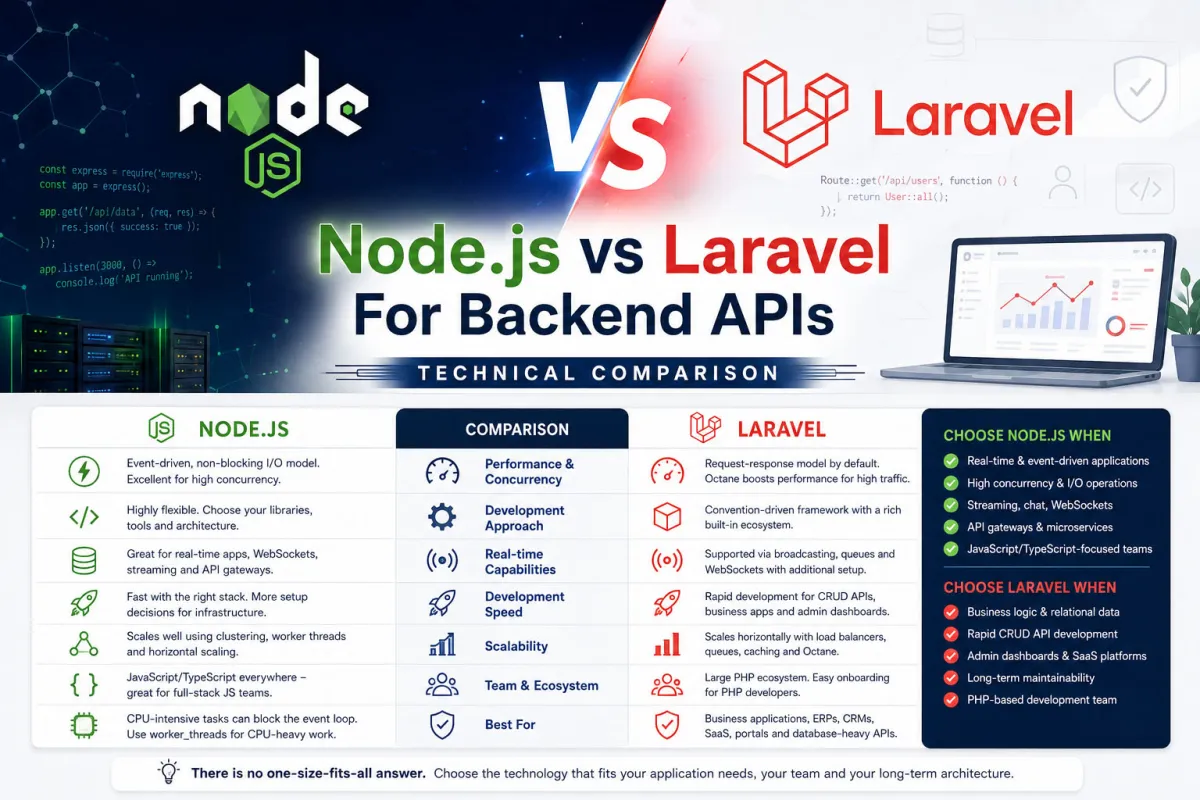
Node.js or Laravel for backend APIs? Compare performance, concurrency, scalability, develo...
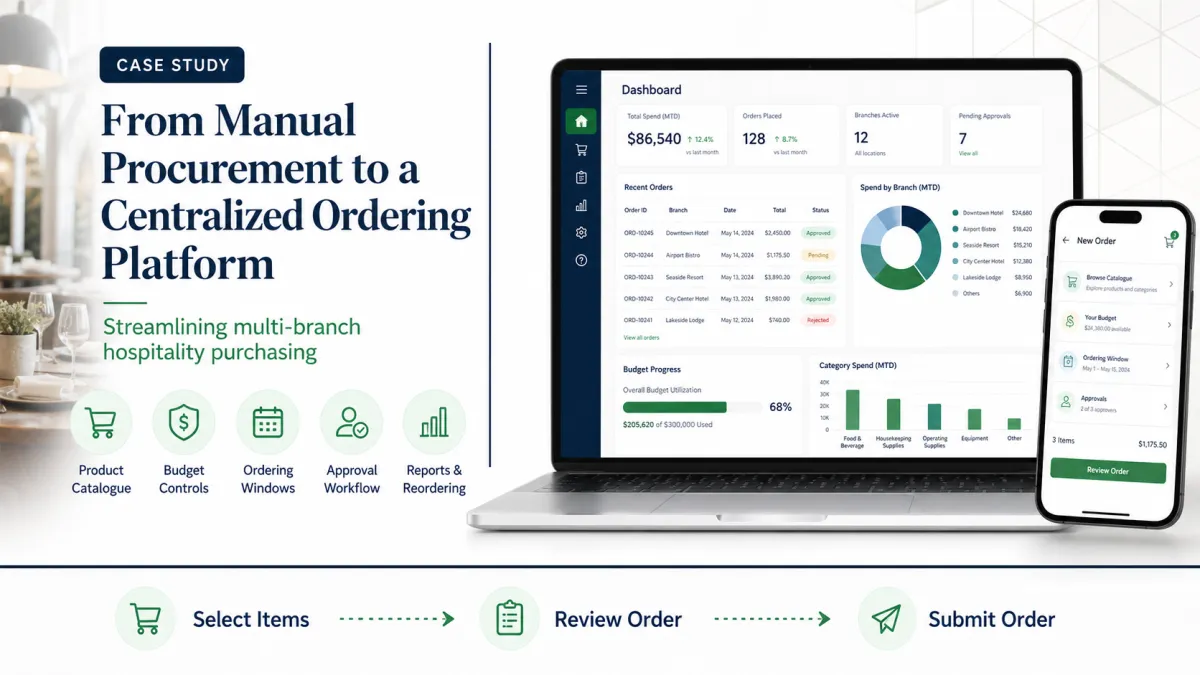
See how we replaced spreadsheets, messages, and manual approvals with a centralized orderi...
Discover the real difference between no-code and custom development. Learn which approach...