How to Grow a Local Business into a National Brand with Digital Marketing
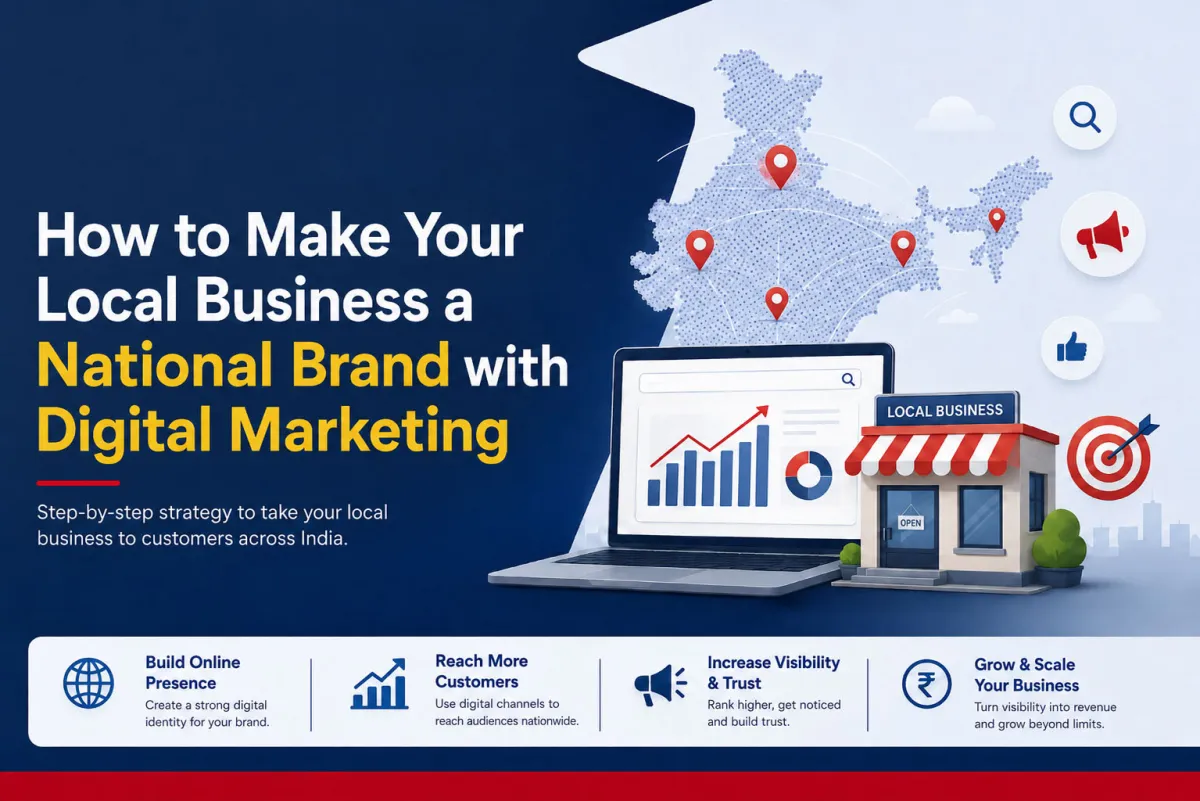
Today, a business is no longer limited by the location of its shop, office, clinic, restaurant, coaching centre, or workshop. Before buying a product or choosing a service, customers increasingly search online, compare options, check reviews, visit social media profiles, and look for reliable contact information.
For small businesses, startups, professionals, home-based entrepreneurs, doctors, retailers, trainers, restaurants, manufacturers, and service providers, digital marketing offers an opportunity to reach the right customers without requiring the massive advertising budgets traditionally associated with large brands.
A neighbourhood bakery may want to reach customers within five kilometres, while a handicraft seller may want to ship products across India. Digital marketing allows both businesses to work towards their goals using different strategies.
The key is not simply to "be online", but to build a digital presence that generates enquiries, trust, customers, and eventually revenue.
What Is Digital Marketing?
Digital marketing is the promotion of a business, service, product, or brand through internet-based channels. These can include:
Websites
Search engines
Social media
Online maps and business listings
Paid advertisements
Email
WhatsApp
Videos
Blogs and educational content
E-commerce platforms
Unlike traditional advertising through newspapers, pamphlets, hoardings, radio, or television, digital marketing makes it easier to measure results.
A business can track how many people saw an advertisement, visited the website, clicked a button, sent a WhatsApp message, called the business, or completed a purchase.
Why Digital Marketing Matters for Local Businesses
One of the biggest advantages of digital marketing is targeting.
A beauty salon does not necessarily need to advertise across the entire country. It may only need to reach potential customers living within a few kilometres.
Similarly, a coaching institute may target students and parents within its city, while a restaurant may focus on customers interested in dining, delivery, or local food experiences.
A strong digital presence also improves credibility. When customers can easily find a business address, phone number, photographs, opening hours, website, services, and genuine customer reviews, they feel more confident about contacting the business.
This is particularly important for businesses that depend heavily on local trust.
Start with Local Search and Online Maps
For many local businesses, online maps and search listings can deliver results even before sophisticated advertising campaigns are required.
Think about searches such as:
"Doctor near me"
"Best restaurant nearby"
"Medical store near me"
"Car repair shop in my area"
"Best coaching centre in Jaipur"
Businesses appearing prominently for these searches have a clear advantage.
Keep your business information complete and accurate:
Business name
Address
Phone number
Working hours
Services
Website
Photos
Map location
Customer reviews also matter. Encourage satisfied customers to share genuine feedback.
Negative reviews should not automatically be treated as a threat. A polite response and genuine attempt to solve the customer's problem can sometimes strengthen trust more than having only positive reviews.
Build a Website When the Business Is Ready
A website acts as the digital office of a business.
Social media profiles are useful, but they operate on platforms controlled by other companies. A website gives the business greater control over its information, presentation, customer enquiries, and search visibility.
A small business does not necessarily need a large or expensive website.
A simple professional website may include:
Business introduction
Products or services
Photos
Contact details
WhatsApp button
Address and map
Customer testimonials
Frequently asked questions
Businesses selling products nationally may eventually require an e-commerce website with online payments, product listings, order management, delivery information, and return policies.
Use Social Media with a Purpose
Creating accounts on every social network is not a strategy.
Businesses should focus on platforms where their customers are most active.
Fashion, food, beauty, travel, fitness, and lifestyle businesses often benefit from visual content. Professional and B2B services may benefit more from professional networking and educational content.
Instead of posting only advertisements, businesses should publish content that helps customers understand their products, services, expertise, and working process.
For example:
A clothing store can showcase new designs.
A bakery can show how cakes are prepared.
A doctor or clinic can share general health awareness information.
A fitness trainer can post practical exercise tips.
A consultant can answer common customer questions.
Useful content builds familiarity and trust before the customer is ready to buy.
Search Engine Optimisation Can Deliver Long-Term Traffic
Search Engine Optimisation, or SEO, helps websites and content appear more prominently when users search for relevant products or services.
Suppose someone searches for:
"Wedding photographer in Jaipur"
A photographer who has a well-structured website containing location information, portfolio examples, customer reviews, useful content, and proper technical optimisation may have a better chance of appearing in search results.
SEO usually does not produce instant results. It requires consistent content, technical improvements, and time.
However, unlike paid advertising, good SEO can continue bringing visitors without paying for every individual click.
Use Paid Advertising Carefully
Online advertising allows businesses to target customers based on factors such as location, age, language, interests, and behaviour.
A small business can start with a limited budget rather than committing large amounts immediately.
Before launching any campaign, decide the objective.
Do you want:
Phone calls?
WhatsApp enquiries?
Website visits?
Store visits?
Appointment bookings?
Online sales?
Search advertisements are particularly useful when people are already looking for a product or service.
Social media advertisements can be useful for generating awareness among people who may fit the target audience but are not yet actively searching.
Start small, measure results, identify which audience and advertisement perform best, and then increase spending gradually.
Content and Video Build Trust
Content marketing is not just about publishing blogs for SEO.
Useful articles, short videos, guides, FAQs, demonstrations, customer experiences, and educational posts can help a business establish authority.
A paint supplier could explain how to choose colours for different rooms.
A financial consultant could publish budgeting tips.
A travel company could create destination guides.
A bakery could show the preparation of a customised cake.
Videos do not necessarily require expensive equipment. A good smartphone, proper lighting, clear audio, and a useful message are often sufficient.
The objective should be usefulness and credibility rather than perfection.
WhatsApp and Email Can Improve Customer Relationships
WhatsApp is especially useful for local businesses because customers already use it every day.
It can be used for:
Appointment confirmations
Order updates
Customer support
New service announcements
Limited promotional offers
However, businesses should avoid repeatedly sending unsolicited promotional messages.
Email can be useful for businesses that regularly share offers, educational material, product updates, events, or newsletters.
In both cases, permission and relevance matter more than sending messages frequently.
How Much Should a Small Business Spend?
There is no universal digital marketing budget.
The right amount depends on the business, market, competition, location, customer value, and growth goals.
A practical small-business budget can be divided into three areas:
Content creation: photographs, videos, graphics, articles.
Advertising: search and social media campaigns.
Digital infrastructure: website, hosting, tools, analytics, and related services.
A business can begin with a modest amount and test different approaches.
The important point is not to spend the entire budget immediately.
Run small experiments first. Identify which campaign produces enquiries and sales, then scale the successful ones.
Likes and followers should not be treated as the primary measure of success.
More meaningful outcomes include enquiries, calls, appointments, orders, store visits, sales, repeat customers, and customer acquisition cost.
A Practical Digital Marketing Plan for Small Businesses
Businesses can follow a simple sequence:
Define the goal: awareness, enquiries, sales, or expansion.
Identify the ideal customer.
Create accurate business profiles and map listings.
Build a website if the business requires one.
Publish useful and consistent content.
Encourage genuine reviews.
Start small advertising experiments.
Track enquiries and sales.
Improve what works and stop what does not.
This approach is far more sustainable than trying every available digital channel at once.
Common Mistakes to Avoid
Small businesses often make the mistake of creating multiple social profiles and then abandoning them.
Other common problems include ignoring customer messages, displaying outdated business information, buying followers, using fake reviews, and expecting immediate results.
Digital marketing takes time because customers need repeated exposure before they recognise and trust a business.
Businesses should also avoid relying only on discounts. Competing solely on price can make customer retention difficult once regular pricing returns.
Instead, communication should highlight quality, convenience, customer experience, expertise, reliability, and the unique value the business provides.
From Local Presence to National Reach
Digital marketing can eventually help businesses move beyond their local market.
Products such as handicrafts, clothing, packaged foods, beauty products, books, and speciality items can potentially reach customers throughout India.
Professionals can offer consultations remotely, while trainers and educators can create online programmes or courses.
However, national expansion requires more than advertising.
The business must also be prepared for increased demand, customer support, packaging, payments, delivery, returns, pricing, and regional preferences.
Different states and audiences may also respond differently to language and promotional messages.
Conclusion
Digital marketing is not simply about running advertisements.
It is an ongoing process of understanding customers, providing useful information, building trust, communicating effectively, measuring results, and improving the strategy based on real data.
Small businesses can begin with social media, online maps, WhatsApp, reviews, and local advertising. As the business grows, it can add a professional website, SEO, content marketing, e-commerce, and national advertising campaigns.
A large budget is not always necessary.
Clear goals, useful content, consistency, customer service, and data-driven decisions matter far more.
A business that builds a strong digital identity today can strengthen its position in the local market while creating opportunities to become a recognised brand far beyond its original location.
FAQ
1. Is digital marketing useful for very small businesses?
Yes. Local businesses can target specific neighbourhoods, customer groups, and interests without needing a nationwide advertising budget.
2. Does every small business need a website?
Not immediately. A very small local business can start with social media, map listings, and WhatsApp. A website becomes increasingly valuable when the business wants better search visibility, online bookings, detailed information, or national sales.
3. How much should a small business spend on digital marketing?
Start with a manageable test budget. Measure enquiries and sales before increasing advertising expenditure.
4. Which is better: SEO or paid advertising?
They serve different purposes. Paid advertising can generate faster visibility, while SEO is a longer-term strategy for attracting organic search traffic.
5. How can a startup identify its target audience?
Run small experiments with different customer groups and messages. Speak directly with early customers, collect feedback, and use actual enquiry and sales data instead of relying only on assumptions.
6. What should businesses measure?
Focus on calls, WhatsApp enquiries, appointments, leads, orders, sales, repeat customers, and customer acquisition cost rather than only likes and followers.
Build a Repeatable Growth System
As your reach expands, professional digital marketing services can coordinate campaigns across channels. Start with search engine optimization, use focused keyword research, and measure results with reliable SEO tools. These foundations help you increase website traffic as the business grows.
Tagged in

Written by
Madhavendra DuttI build modern, high-performance websites and provide secure hosting and strategic digital marketing solutions that help businesses grow online. My focus is on clean development, speed, reliability, and measurable results.
View all posts →Related Posts
Continue exploring similar topics

If you have a website, you should always ask yourself how to grow and improve your online...
If you know important SEO tools, then you can use them in developing your business. Master...
Keyword research tools are basic tools in SEO. Keyword research is the process by which yo...